
We want them back! Some thoughts on out-of-production kits

Updated: May 10
For us modellers specialized in 1/48 WWII warbirds, it can be stated that we live in the Golden Age: new kits are constantly being released with highest quality standards or re-released, re-seller markets have made second-hand or out-of-production kits available worldwide via internet, and nearly every niche has been covered by aftermarket or limited run companies.
However, we still don’t seem to be satisfied and keep asking for new stuff. On the other hand, we also tend to deplore what is no longer available, and I admit to belong to the latter category.
Although my stash already contains more kits than I will ever be able to build and is constantly growing, I would be happy to see some long gone kits either re-boxed or re-tooled.
If manufacturers are reading this article, here are a few ideas (and my personal selection):
Dewoitine D.520 (Tamiya, 1996)

During the past decades, WWII aircrafts of the French Armée de l’Air has been a totally neglected subject by nearly all mainstream manufacturers – and regrettably still is today.
While one can only speculate about the reasons for this lack, fact is that the French aviation industry had produced quite a number of planes on the verge of WWII that modellers could build into a beautiful little collection: The Morane-Saulnier MS 406, Marcel Bloch 151/152/155, Arsenal VG 33/39 and Caudron-Renault CR 714 all are attractive birds, each of them featuring a unique camouflage pattern and – if so you wish – colourful Vichy marking options.
Limited run manufacturers like Classic Airframes, Azur and – more recently – the excellent Dora Wings offerings have filled this gap. But apart from a rather mediocre MS 406 released by Hobbycraft in 1991, the only kit from a main company that I can think of is Tamiya’s Dewoitine D.520. It was first issued in 1996 and re-boxed a few times since.
Unfortunately, it seems to have completely disappeared from their catalogues. The kit’s quality is beyond all doubts, being typical mid 90ies Tamiya “shake n bake”.
Aside from that, low availability and high price tags at eBay indicate that modellers would like to see this kit re-issued.
Vought OS2U Kingfisher (Monogram, 1966)
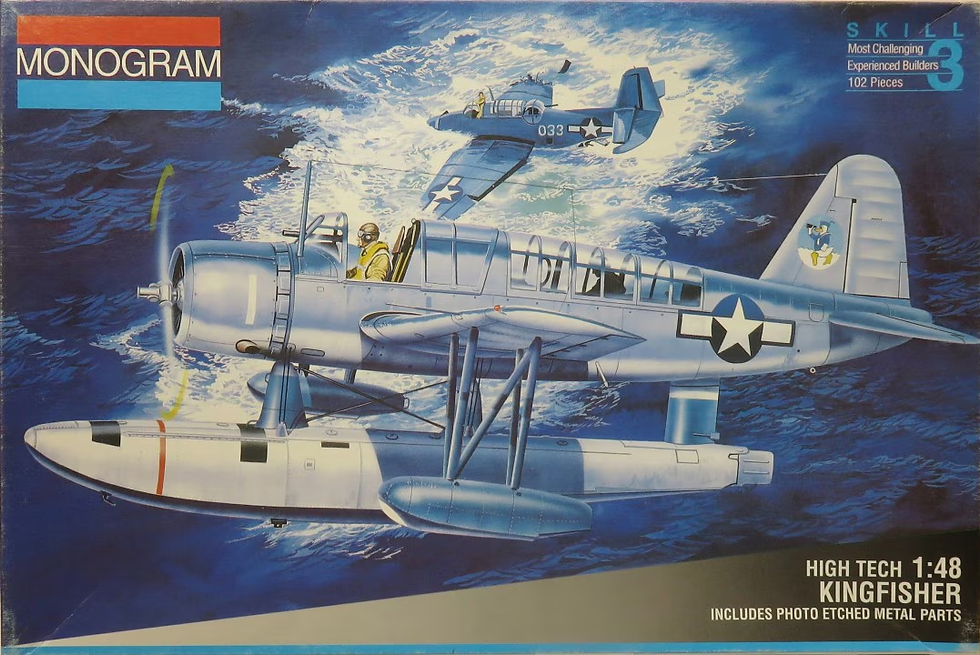
Initially introduced around 1940 and built over 1500 times, the Kingfisher was not only the standard reconnaissance plane aboard of most US Navy major vessels, but also a versatile, multipurpose workhorse on both water and land throughout entire WWII and beyond.
From a modelling point of view, the Kingfisher is of interest for several reasons: The wide glasshouse canopy offers room for plenty of cockpit detailing that also remains visible after completion, the construction is unique and complex enough for both a challenging build and an eye-catcher of the finished kit, and painting options cover the full US Navy colour ranges from pre-war “yellow wings” to overall Sea Blue finishes. Furthermore, being used by no less than 9 different countries throughout its service history and featuring interchangeable float and landing gear, modellers could fill entire shelves of Kingfishers where two wouldn’t look alike.
The only 1/48 Kingfisher ever available (!) was released by Monogram in 1966 and re-boxed multiple times with minor changes and upgrades by several companies, especially Revell. All of those kits feature raised panel lines, crude and basic details and some inaccuracies in shape, the most obvious one being the hopelessly undersized main float. These flaws are naturally due to the age of the moulds and their by-the-time limitations in fabrication processes.
Although some aftermarket correction kits have been produced, wouldn’t this iconic plane deserve to be re-tooled with up-to-date standards?
Grumman F3F-1 (Accurate Miniatures, 2000)

When Accurate Miniatures released their Grumman F3F boxes as of 2000, these kits were highly praised – and rightly so: A beginner-friendly, accurate, well detailed and perfectly fitting biplane! With PE parts for the rigging! Plus, a decal sheet that would allow you to build ANY of the schemes that were brought to service! What else could one ask for?
Especially the decal sheet was a very attractive feature, considering that most of the F3F had the colourful Neutrality Patrol "Yellow Wings" schemes applied. It enabled the modeller to pick his favourite combination of tail / cowling & fuselage band colours.
This kit simply was a jewel!
Sadly, Accurate Miniatures is now defunct. At the time, they had released 2 versions of the kit: The two-blade propellered F3F-1, and the F3F-2 featuring a three blade propeller. Both included the full decal sheet.
Academy has released some of the former AM kits, with the F3F-2 among them (get one while they are still available!). Thankfully, they retained the PE parts, but reduced the decals. Hence, a re-box of the F3F-1 with the initial decal sheet would be a very welcome addition to Academy’s line up…
Vickers Wellington (Trumpeter, 2006)

In warbird history, the Wellington played a major role during the numerous night raids onto German territory especially in the earlier days of WWII. At the time, it was the RAF’s heaviest 2-engine bomber and also labelled as such, until the 4-engine heavy bombers Short Stirling, Avro Lancaster and Handley Page Halifax were introduced into service. Up to this day, the “Wimpy” remains the most built RAF bomber with over 11.000 units produced!
From a modelling perspective, it seems to me that the Wellington has stood a bit in the shadow of her bigger sister and cousin, the Lancaster and the B-17 as its US counterpart. Both of the latter were first issued in the 70ies by Tamiya (Lancaster) and Monogram (B-17), which might have saturated the small market for big birds. However, considering the existence of a 1/48 B-29 and the absence of above mentioned Halifax and Sterling, this remains an assumption.
One can blame Trumpeter for many things, but they deserve kudos and respect for giving us the only two available versions of the Wellington in 2006 and 2007 ever released (and for their Focke Wulf Fw 200 as well, by the way). No other manufacturer has tackled this subject before or after.
Despite some issues with the kit’s quality, I would already be more than happy with an affordable rebox.
Dornier Do 17 E/F (Hobbycraft, 1991)

The sleek Dornier Do 17 was a typical German pre-war development that was designed as “civil” aircraft under the constraints of the Versailles treaty, which did not allow Germany to build military aircraft. As such, the earlier E (bomber) and F (reconnaissance) versions did not see much combat and were retired after the Battle of Britain. They were replaced by the later Z and 215 versions and by more modern designs like the Heinkel He 111 or the Junkers Ju 88.
There are good kits of the later Do 17 Z and Do 215 available, notably by ICM and re-boxed by Eduard. However, the earlier E and F versions had a considerably different appearance, mainly due to their nose, engine nacelles and two blade propellers.
Hobbycraft issued all earlier E, F, M and P versions, but these kits were very basic, benevolently spoken challenging (“unbuildable” being the more appropriate term) and had quite some shape issues.
However, price tags on second hand platforms for these boxes are very high, provided you can find one at all.
While plenty of German wartime twin-engine birds are widely available, the count gets low when it comes to pre-war or Spanish Civil War machines. It is the option for a three-tone camouflage scheme of RLM 61/62/63 that makes an early Do 17 desirable.
I am still hoping for ICM’s apparent affinity and productivity for German twin-engine birds on this one…
What kits do you want back?
This is just a small selection of a few birds that modellers may like to see resurrecting on the markets. There are many more, and I might cover some of them in another post.
If you have any ideas for the topic, leave a comment or drop me a mail!

Comments