
First kit recommendations

Updated: May 5
This article contains my personal suggestions for kits that are perfectly suited for beginners, but will also satisfy the demands from advanced modellers. I have built all of them, so that I can provide you with direct information.
The selection is based upon the following criteria:
Clean parts with good fit and straight-forward buildability
Reasonable part count
Acceptable amount and quality of detail, while not over-engineered
No overly complex camouflage schemes
Affordable price tag with good value for money
The date references to the year when the kit was first released with new moulding tools.
P-51B Mustang (Tamiya, 1995)

If I was to start all over again, this would be my top pick for a first kit build. Released a few times in both B and D versions, it is widely available at reasonable prices. This kit was the benchmark for roughly 20 years until Eduard released their own P-51 family, which is superior in terms of accuracy and details - but also complexity. While the Olive Drab / Neutral Gray scheme of the B version is rather simple, the D version is a good candidate for your first Natural Metal Finish (NMF).
The main criticism points were the flat cockpit floor and the inaccurate moulding of the wheel wells. Unless you want a competition winner, both flaws are neglectable.
Messerschmitt Bf 109F (Hasegawa, 1991)

The 90ies were perhaps the era of the closest competition between Tamiya and Hasegawa, which is always in favour of the consumer – us modellers. While both companies had E and G versions of the Bf 109 family in their portfolio, only Hasegawa released an F version. These kits were the gold standard until Eduard turned the entire Bf 109 market upside down with their new tool releases from about 2012 onwards.
The Hasegawa Bf 109 F kits are straight-forward, simple builds that end up into good looking models. In line with Hasegawa’s strategy, this classic topic has been re-boxed multiple times, covering almost every painting and marking option for every theater of combat.
My recommendation for starters would be a Bf 109F-4 Trop version with the 2 tone RLM 78/79 scheme.
Macchi C.205 Veltro (Italeri, 2016)
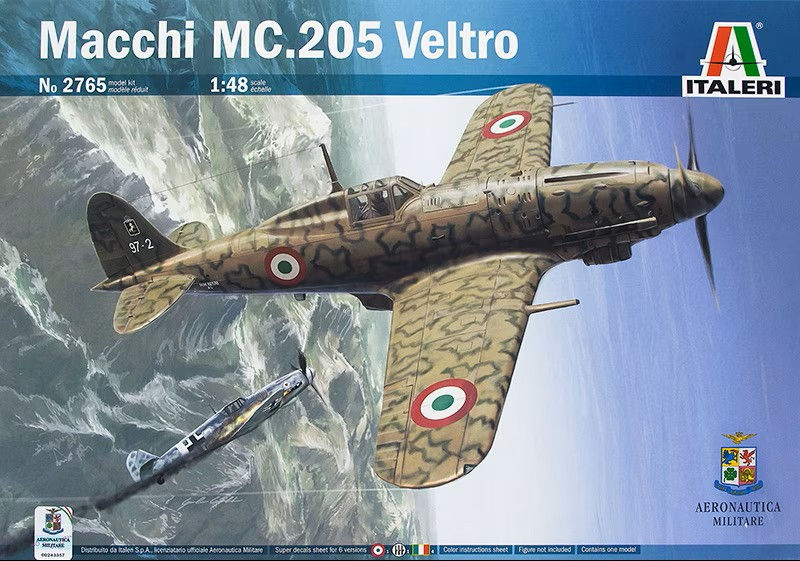
The label states Italeri, but the sprues come from Hasegawa and were initially released in 1994. As for the other Hasegawa recommendations in this post, you will have a well-engineered, straight forward buildable kit with good fit in your hand.
What makes the Italeri Veltro more desirable than the Hasegawa offerings is the decal sheet, which will bring considerable added value: not only is the quality superior to the standard Hasegawa decals, but it also includes a full set of “smoke rings” of excellent color and quality for the paint scheme. Italian camouflages are generally amongst the most challenging and interesting ones in the modelling world, and the final result on the finished kit is quite impressive.
You can of course also pick a regular Hasegawa Veltro or one of her sisters, the C.202 Folgore. The plastic parts inside are basically the same.
Messerschmitt Bf 109E-3 (Tamiya, 1996)

During the 90ies, Tamiya issued a number of single engine WW2 fighters that consolidated their well-deserved reputation of “shake n bake” kits.
The Bf 109 E-3 is one of them, as well as the very similar E4/7 release. The early Bf 109 E-3 generally featured the splinter camouflage, but without the mottling on the fuselage, both contributing to an attractive yet easily achievable painting process.
You may also opt for a Tamiya F4U Corsair, a F4F Wildcat, a more recent P-47 or a Dewoitine D.520 (if you can find one at a reasonable price), all from that era. All of them can be built into little gems, and I recommend them all. Except for the latter, all these kits have recently been redesigned with modern CAD mouldings by other companies. This leads to affordable prices and good availability.
Messerschmitt Bf 109E-3 (Hasegawa, 1998)

Issued as a direct competitor only 2 years after the Tamiya release (see above), the Hasegawa offering of this same subject is very similar in every respect. Engineering, details, overall quality, part count and breakdown are fully comparable and at equal level.
As opposed to the Tamiya kit, the Hasegawa Bf 109s are currently out of production. However, they are likely to be re-released sooner or later in accordance with Hasegawa’s strategy to rebox the same mouldings all over again.
If you fancy an early Bf 109E, both are equally good picks. The choice will basically be determined by personal preferences, availability and the price tag.
P-47D Razorback (Monogram, 1977)

Yes, Monogram. Unfortunately, this iconic American manufacturer went out of business 40 years ago, being artificially kept alive by Revell for another 20 years. Actually, Monogram has set the gold standard for over 2 decades, offering the best balance of cost, detail and accuracy. Some of their kits are still being re-issued to this day, mainly by Revell, using the original moulds.
All kits of their former range are totally outdated by today’s standards – but some are more than others. While I strongly recommend to avoid early kits such as the Corsair or the Dauntless, later releases from 1975 onwards generally feature good fit, acceptable details, accurate shape and excellent buildability, despite their raised panel lines. Both the P-47D Razorback as well as the Thunderbolt with its bubbletop hood fully fit into that grid.
Due to their log term mass production, most Monogram kits are still available on second hand platforms and sought-after classics. A Revell-issued box will also do the trick. Why not start with one?
Mitsubishi A6M2 Zero (Tamiya, 1973)

Although re-engineered by Tamiya in 2008, I deliberately suggest the initial release from 1973 of Tamiya’s Zero. In fact, together with the Brewster Buffalo released 1 year later, this kit marked a turning point for the company by the high standards that were set with it, already featuring partially recessed panel lines.
Low part count and excellent fit make this a very suited beginner kit, which has stood the test of time. Even by today’s standards, it can be built into a model that will still look good next to much more recent kits.
Throughout the last years, the market for A6M Zero kits has been flooded with modern releases by Hasegawa, Tamiya and Eduard. Hence, you can find boxes with the initially moulded parts at very cheap prices – also purchasing a milestone in modelling history.
I hope that these suggestions can be of any use when considering what to start with. If you have actually picked a kit from this list as your first kit – leave a comment or drop me a mail, I am curious about your feedback!


Comments